I mentioned this article by Al Mohler tonight at Grace @ Night concerning our desire to be accepted as “cool” in the culture. Helpful to think through in light of 1 Corithians 1:10-31.
Category Archives: Uncategorized
What books has President Bush read recently?
Karl Rove has the answer in the Wall Street Journal.
Download-able Sermons
Random moment of self-promotion: Here is the link for my Grace @ Night sermons available for download, if anyone is interested. You can also find them on iTunes.
Jesus said to visit the prisoner…
…I’m not sure this story of high school football is what he had in mind, but it sure follows the spirit of the law.
Jesus is My Friend
Funny how things get dated so quickly. Merry Christmas, everyone.
Theology for the little ones
Andy and Jenni Naselli offer up some of their favorite kids books for the parents among us to consider.
(HT: Justin Taylor)
“The Faith” – Chapter 2
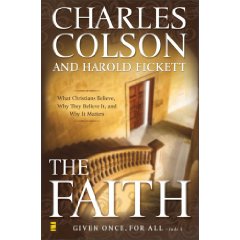 (Sorry for the delay in getting up the next post)
In Chapter 2 Colson builds his case for the faith with the oft-discussed issue of God’s existence, responding to “anti-theists” (his term) such as Sam Harris and Christoper Dawkins.
I lifted Stuart’s comment from the thread below, because I thought he had a good summary and insight about this chapter: “In chapter 2 Colson talks about the proposition that “God is”, and 3 ways to look at that – logical, irrational, etc. Often times when I encounter people who don’t believe in God, or doubt God, they don’t seem to think of it so much as whether it’s rational or logical or not. More of their problem or disagreement (and why they don’t believe in God) seems to be that they don’t want to be limited or restricted in their freedom of thinking. It boils down to “moral relativism” or “situation ethics”. They don’t want to follow or believe in something that doesn’t allow them to make up their own rules. They don’t even bother with the scientific arguments.” (emphasis added)
I have met many people who don’t want to decide one way or the other, hoping to maintain moral autonomy and the option to pray when they wish.
Do you agree with Colson and Stuart’s experience (that there are more pragmatic atheists than logical atheists)? Have you found yourself tempted to validate anti-Christian behavior with doubts about God or the gospel?
Introduction to “The Faith” by Chuck Colson
Thanks for joining me in reading through Chuck Colson’s, The Faith. If you don’t have a copy of it yet, you can find it at Border’s, or order it from Amazon.com here.
I’ll be posting twice a week, probably on Monday and Thursday, with a chapter each time. I’ll close each post with a question to launch the conversation in the comments section. Here’s today:
Why did you choose to read this book? What are you hoping to get out of it?
“That Hideous Strength” by C.S. Lewis
The Good: Lewis dubbed this a fairy tale for grown-ups. He delivered. It’s fantasy, certainly, but a brilliant portrayal of the effect of ideas. The narrative moves briskly (after a slow start), and many chapters leaving me saying, “Wow” at the end of them. Easy to find in paperback, and cheap, too.
The Bad: The aforementioned slow start. His generous use of biblical and literature allusions will leave some more confused than riveted. Some parts of the text are seen to be mildly chauvinistic.
The Grade: A- (Sure to read again at some point, docked points only for the slow start)
Religion
Being a pastor, the easiest part of Facebook to fill out should be the “Religion” field. I simply put “Christian.” Little did I know that there would be such diversity among my friends and family among how to accurately represent themselves in this important area of life. Among those who all go to the same church I found the suggestions, “Protestant,” “Presbyterian,” (though we’re not actually at a Presbyterian church) “Christ follower,” “God lover,” and many others.
Is this a good thing or a bad thing? Does it reflect a yearning to convey our strong conviction, something that the generic “Christian” might not? Or is this simply our generation’s discomfort with titles showing itself again? Christians have been called such for 2000 years. Does holding the title show solidarity with the past, or simply a lack of creativity on our part?
 Bob Wriedt